Writing Samples
Joy | Sorrow | Attraction | Disgust | Amusement | Anger | Excitement | Anxiety | Pride | Embarrassment | Gratitude | Jealousy

Joy
Excerpt Setting: Waldorf Astoria Hotel (New York City, NY, 1994)
This excerpt was taken shortly before Christmas, in the Fall of 1994. I was routinely visiting New York City a week each month to call on hospitals around the area and decided to invite my mother to join me on the trip. I had taken my parents and little sister, Pamela a decade earlier during the hot summer months and I recall my mom commenting on how beautiful NYC was during the Christmas Holidays. In fact, as young children, we always sat in front of Grandmother’s television to watch the iconic Macy’s Thanksgiving Day parade, considered by many to be the official kickoff to the holiday season in the United States. I chose for us to stay at the famous Waldorf Astoria Hotel on Park Avenue because it was well-known for transforming its lobby into a holiday movie set with towering trees, twinkling lights and themed displays. We had an amazing week, but due to my mother’s rapidly advancing dementia, I tried to keep a close eye on her whereabouts at all time. However, you would be remiss if you do not read further to discover mom’s little side excursion that was as terrifying as losing a small child in a busy shopping mall but had a surprisingly uplifting and JOYFUL ending. Enjoy!
Sample #3
Ch. 33 (A COOKIE for PUPPY GIRL) – Did Someone Say Waldorf Astoria[1]
Mom’s health continued to deteriorate so I decided to have her accompany me on my final trip to New York city just prior to Christmas, and I am really glad I did. I had accumulated enough travel rewards to stay at the downtown Waldorf Astoria. During the day, she visited hospitals with me and patiently sat in the waiting room, knitting a sweater for one of her grandchildren. One evening we attended ‘The Nutcracker’ at the Lincoln Center followed by a visit to Rockefeller Center to see the famous Christmas tree and on another we shared dinner at Tavern on the Green in Central Park but the highlight of her trip came rather unexpectedly. On one of the days, I was unable to take her to the hospital because I was meeting with a client so mom and I enjoyed an early breakfast at the hotel together and I arranged (with the concierge) for lunch to be brought to her room midday. Again, recall that mom was often confused so I would leave notes all over the room reminding her when I would return and NOT to leave the hotel room but when I arrived back at the hotel around 5 pm, mom was nowhere to be found. I checked the entire hotel and was about to panic when the same concierge informed me that around 2 pm he saw mom heading out of the hotel onto Park Avenue (at 34th Street) by herself. Thankfully, he caught up to her and she excitedly replied that she had always wanted to visit Macy’s Department Store, especially during the holiday season, so apparently, she was prepared to make the fifteen-block trip to Macys on her own. He quickly summoned the hotel’s limousine and assigned one of his assistants to accompany her on an extravagant shopping trip to Macys for the next couple of hours, reminiscent of the Hollywood movie, ‘Pretty Woman’.
In reflection, there were no cell phones at the time, so clearly, the concierge had made an incredibly caring decision to have someone ‘shadow’ her, and avert disaster for which I bestow him with the Cookie for Puppy Girl Lifetime Award.

I’ll never forget watching Mom pull up to the Hotel in a black, stretch limo moments later and entered the lobby, with a smile that lit up the room. That (JOYFUL) moment is how I choose to remember her forever.
_______________
[1] Disclaimer: This excerpt and corresponding writing sample display some color but the actual book is in black and white.
Joy
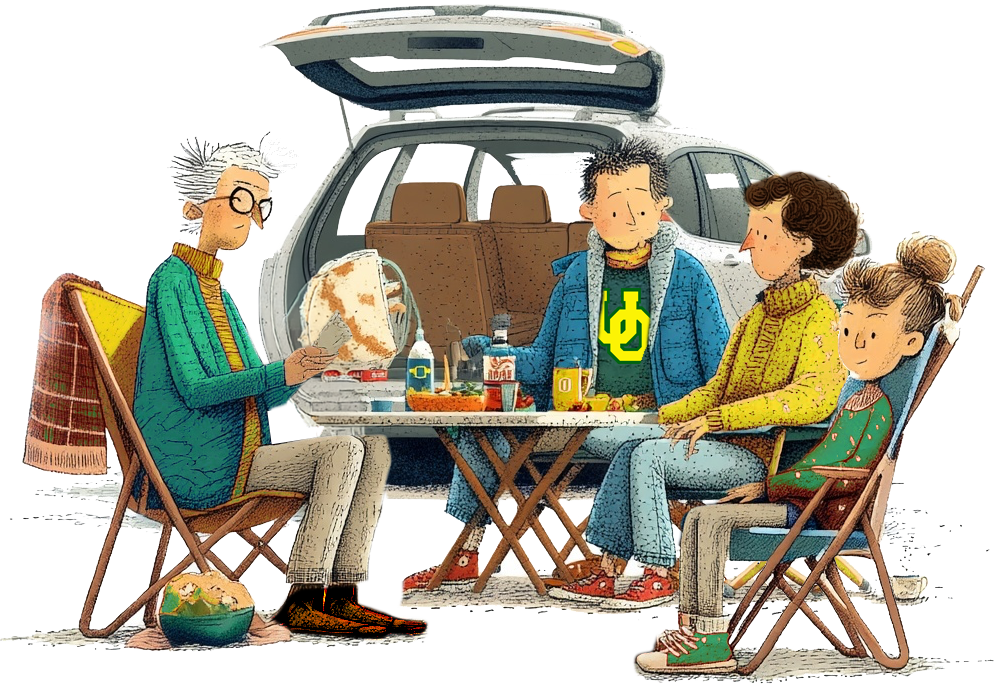
Excerpt Setting: Autzen Stadium, University of Oregon (Eugene, OR, 1974)
This excerpt opens the book in 1974 as I was just entering college at the University of Oregon (UO) in Eugene, Oregon, as an 18-year-old freshman. I was arriving in town early because I had been awarded an athletic (tennis) scholarship so I was expected to report for practice immediately. I planned to live in the student dorms for my first year but also planned to check out fraternities. The story centered on our family’s struggle to balance the JOY of being part of a close-knit family with the challenges of adjusting to a father who was suffering from crippling PTSD symptoms from serving on the front lines in World War II. Enjoy!
Sample #2
Ch. 1 (A TURD in THE PICKLE JAR) – Autzen Stadium is My Happy Place[1]
Not surprisingly, Eugene’s population would nearly double in September when the students returned to campus, just in time to support our struggling football team. However, that didn’t stop the fans from pouring into our recently constructed (1967) Autzen Stadium, just a short hike from campus across the Willamette River foot bridge. This bridge helped connect the numerous jogging trails in Alton Baker Park, and was inspired by our world-class Track & Field program as well as Nike co-founders and UO alumni, Bill Bowerman and Phil Knight who helped Eugene earn its nickname as ‘Track Town U.S.A’.
I was already a loyal UO football fan, having traveled to Eugene from my hometown of Roseburg, for countless games over the previous ten years. Roseburg was a small lumber-mill town and although it was located just an hour south of Eugene in distance, culturally, it might as well have been a million miles away. However, I consider myself fortunate to have been raised by highly educated parents and extended family who, in turn, emphasized education and provided a perspective on life that promoted diversity, equity and inclusion. In fact, Mom and Dad both graduated from renowned universities and both taught English literature in the local public school system.
Many of my fondest memories include loading up the family’s Buick station wagon, with side wood-panels, of course, and heading up to the games, where my older brother, Rick, and two older sisters, Paula and Heather, eventually attended UO. In fact, on a typical Saturday morning, my parents, my (much) younger sister, Pamela and I would arrive in the expansive parking lot, rain or shine, for a ‘pre-game’ celebration or what we called, at the time, a ‘tailgater’. Mom would always make at least a couple dozen sandwiches of all varieties, not knowing who, or how many people would show up, but somehow, they always seemed to get devoured on game day. To add to the festivities, there were always chips, especially Doritos, fruit, raw veggies, and home-baked cookies that were to-die-for. Of course, we also brought a football along and could usually get a game going between the parked cars.
As game time neared, we would head inside the stadium, and unlike nowadays, where all of the games are sold out with more than 65,000 fans, we would be lucky to have 15,000 fans, which meant we could sit wherever we chose and spread out. To add insult to injury, UO did not have a typical marching band as was customary among other schools, especially those visiting from the Midwest. Instead, we had a five-member rock band anchored in the middle of the half-empty, apathetic student section, complete with electric guitars and a drum set. Not surprisingly, they sounded dreadful, and certainly couldn’t play the University’s fight song as it was intended, but it really was reminiscent of the rebellious times we lived in during the 1960’s.
Occasionally, the team would fall hopelessly behind on the scoreboard, prompting fans to head for the exits by the middle of the third quarter, but we never, ever left a game early because Autzen Stadium was and still is ‘My Happy Place’. It remains our time-honored tradition, which has lasted more than sixty years to date, where our family and many of our friends, have come together to enjoy each other’s company several different times each Autumn. In fact, after Mom and Dad’s passing many years ago, I sprinkled some of their ashes in the northern corner of the east endzone, and it is my hope that my family will do the same for me when my time comes. Incidentally, for you UO Duck fans, that is right where Kenny Wheaton intercepted a pass from University of Washington and ‘took it to the house’ on the final play of the game that preserved the win, propelled the Ducks into the 1995 Rose Bowl for the first time in a generation and changed the football program’s trajectory forever.
In reflection, that truly JOYOUS moment is bittersweet when I realize that it was the final game that we all attended together before my parents’ passing. However, more importantly, our family enjoyed countless games together for more than thirty years that kept us connected generationally, not only with each other as the family grew with in-laws, cousins, grandchildren and so on, but also served as the ideal stage to introduce friends and friends-of-friends at these time-honored tailgaters, because one thing for certain, everyone was always welcome, and Mom would always have a roast-beef sandwich to offer up.
For years I tried to fully grasp why Autzen Stadium was ‘My Happy Place’ because I have visited some pretty amazing and inspiring places around the world over my lifetime. However, I finally came to the realization that it wasn’t the physical locale that evoked my overwhelming joy but rather the idea that we were all together as one cohesive and loving family. Contrast that to the typical Friday night growing up in our family home in Roseburg, on the night preceding the football game. Instead of coming straight home and spending time with us, playing tennis or just hanging out, Dad would stop at the tavern on old Hwy 99 for a beer and drink until he could barely drive home and stumble into the house. He chose ‘Colt 45’ a cheap, malt liquor known for its higher alcohol content because he could get drunk more quickly, and I believe the higher sugar (malt) content gave him an extra rush of adrenaline (energy). It should also be noted that Dad had served in Europe during World War II, hitting the beaches of Normandy on D-Day in 1944 and fighting all the way through northern Europe with General George Patton’s Third Infantry. He fought in five separate battle campaigns and took three separate German bullets in his ankle, shoulder and hand for which they awarded him Purple Hearts, patched him up and send him directly back to the extreme frontlines until we won the war in Europe (1945). Hundreds of his friends and fellow comrades died beside him in combat, and although the term had not been officially defined yet, Dad suffered from some of the worst PTSD effects imaginable. His nightmares were so bad that he would wake up most nights screaming and as children we were never allowed to come into our parents’ bedroom at night and we were never ever allowed to have anyone sleep-over. When he arrived at home, he would scream loudly into the phone for hours with a few of his closest friends from the war, amassing long-distance phone charges that were staggering, especially on a teacher’s meager salary. Then, when Mom would finally wrestle the phone away, he would play music on our Magnavox at full volume and he usually sobbed uncontrollably until Mom was finally able to get him into bed. It only happened on Friday nights, but it happened EVERY Friday night for years and years, accounting for my entire childhood until I left for college.
My point is that Dad was suffering from the horrors he had witnessed, and in some ways, he never really came home from World War II. His tortured soul never fully recovered as he relived nightmares, night after night with no way to escape. I can’t imagine how Mom endured this version of hell, but I do know she certainly deserves sainthood for her understanding. In the meantime, I am so appreciative to present her with a Cookie for Puppy Girl Award[2], posthumously, for keeping our family together and giving my siblings and I an otherwise wonderful childhood.
Yes, Dad could be a ‘son-of-a-bitch’ on those Friday nights, but I guess we all chose NOT to totally disregard his otherwise honorable qualities as a husband and father the rest of the time because of the atrocities of a war that he had no control over and dramatically affected him with PTSD forever. With that said, I now realize that after one of those typical Friday nights, we all got up Saturday morning, drove to Eugene and watched UO play a football game with thousands of enthusiastic fans joyously singing while the marching band played the school’s fight song, ‘Mighty Oregon’ (Perfect, 1915).
Oregon, our Alma Mater,
We will guard thee on and on
Let us gather ‘round and cheer her,
Chant her glory, Oregon!
Roar the praises of her warriors,
Sing the story, Oregon,
On to vict’ry urge the heroes
Of our Mighty Oregon!
Instantly, we were a cohesive and loving family again, finding joy in each other as any lingering memories of the night before were erased from our mind, at least for that moment. Yes, Autzen Stadium was my happy place, or should I say ‘My Happy Escape’?
__________
Perfect, A.J. & Gilbert, D. (1915). “Mighty Oregon” [Song]. University of Oregon Marching Band [Recording].
[1] Disclaimer: This excerpt and corresponding writing sample display some color but the actual book is in black and white.
[2] Inspired by and awarded to those special individuals who display kindness toward others without expecting anything in return. Note that this image uses color whereas the actual memoir is in black and white.

Joy
Excerpt Setting: Grandparent’s Home (Roseburg, OR, 1960)
This excerpt opens Section II of the book in 1960 in Roseburg, a small lumber town in southern Oregon, with me as a four-year-old excited for our family to celebrate the pure JOY of the Christmas holidays. We had been invited to visit my (maternal) grandparents, who lived across town, for a Christmas Eve party complete with cookies and hot chocolate (with marshmallows) while Grandmother recited her clever rendition of The Night Before Christmas poem. She even figured out a way to work in a very special and unexpected gift. Enjoy!
Sample #1
Ch. 41 (A TURD in THE PICKLE JAR) – Holiday Nighties For You[1]
I can’t really say when my earliest childhood memory of Christmas was, but I imagine it was around four years old, which would be in the year 1960. Christmas has always been my favorite time of the year because it seems to release a joyful spirit in most of us that creates more optimism in our own lives and, in turn, makes us kinder toward others. Our extended family, like most, had several cherished traditions, including decorating the home and, of course, the tree, and we would all gather for a Christmas dinner, complete with turkey and all of the trimmings following a lively gift exchange. However, my favorite time was when my grandparents would invite us up to their home on Christmas Eve for cookies and hot chocolate with several marshmallows floating on top. Then, Grandmother would gather us around the roaring fire in the fireplace and recite aloud her rendition of Clement-Clark Moore’s classic children’s poem, ‘The Night Before Christmas’ (Moore, 1823), first published in 1823, which she also named The Night Before Christmas:
Twas the night before Christmas, you’ve heard that before
Where the young people peek and the old people snore.
And Santa comes down with his reindeer and sleigh,
Leaving socks full of presents for children all day.
And, as Santa slid over the oceans and lands
He said to himself, “Now isn’t this Grand!
I’m sure in this weather, I’d go quite insane
If I had to travel by bus or by plane.”
Then just at that moment the reindeer stood still
And Blitzen said, “Fellas, just look at that hill!
Do you know that we’ve labored eight hours today?
I’m ready for rest and a stall full of hay.”
So, Santa yelled, “Giddap”, and gave them a whistle
But Blitzen stood still, and started to bristle.
“I’m tired”, he cried, “And, I’m ready to strike,
You can finish your job on a train or a bike!”
“What’s strike?”, asked the reindeer, “Our work isn’t done.”
“It’s a style in the States”, answered Blitzen, “It’s fun!”
“But who does the work?”, asked Dasher, “I don’t see.”
Let someone else worry”, said Blitzen, “Not me!”
Santa looked at his reindeer, and whispered, “Now boys”
“You know we’ve a sleigh full of presents and toys”
“It’s true”, as Blitz says, “That you’ve had a hard day”
“But you don’t want to quit all your duties this way”
“Why look in the windows in all of the towns”
“And you’re sure to see children in holiday gowns”
“They’ve left all the stockings they want us to fill”
“We daren’t disappoint them, the thought makes me ill”!
Well, they looked and they looked, but strange as can be,
Not one boy or girl dressed for bed could they see.
“It’s a trick!” shouted Blitzen, “Come fellas let’s strike!”
“No one can boss us we can do as we like”.
Then just at that moment they came to a house,
And what did they see . . . a rat or a mouse?
No just two good children named Chrissy and Jed
In holiday nighties, and just out of bed.
“You see”, shouted Santa, “They’re waiting for us!”
“Now get back to work, and stop all this fuss.
“To the top of the porch, to the top of the wall,”
“Now dash away, dash away, dash away all!”
The reindeer sprang up, pulling Blitzen along,
And Santa filled stockings, and sang a glad song
“Hooray for the reindeer who think about others”
The fathers and mothers, the sisters and brothers”
“Who put doing their work ahead of their pay”
“In spite of a tiresome, very long day!”
But wasn’t it lucky the children were there,
With a Christmas tree waiting, and nighties to wear.
For the reindeer might strike. It’s sad, but it’s true.
And that’s why I bring Christmas nighties to you.
Yes, it’s very important, my pride and my joy,
That when Christmas comes, one girl and one boy
Shall wear Christmas nighties the reindeer can see
So that Santa’s long ride can end happily.
And the air can ring out with the greeting that’s right,
“Merry Christmas to all, and to all a good night!”
Grandmother’s version, built on the similar scheme of rhyming couplets, captures the original poem’s essence of Santa Claus and his reindeer delivering presents to families around the world on Christmas Eve. However, the reindeer were tired and wanted to go home so Santa tried to convince them to keep going because all of the children ‘dressed in holiday gowns’ were counting on them. At first, no children could be found, but finally they found Chrissy & Jed, ‘in holiday nighties and just out of bed’.
Grandmother had cleverly introduced her two young grandchildren, Chrissy and Jed (i.e., my mom’s brother, Uncle Jerry’s children) into the story, who saved Christmas, as we learn in the final stanza. . .
But wasn’t it lucky the children were there,
With a Christmas tree waiting, and nighties to wear.
For the reindeer might strike. It’s sad, but it’s true.
And that’s why I bring Christmas nighties to you.
In reflection, my memories of that time are a bit hazy, but over the next years, I can recall the pure JOY in the room as we remained mesmerized and spellbound by the poem’s lyrical cadence, as it built to a crescendo, with our names inserted into the poem. Afterward, there would be wrapped presents of holiday nighties under the tree not only for my two older sisters, Heather and Paula, and me who were all participating in the reading but also for my older brother, Rick, who was closing in on his teenaged years. I am proud to share that this tradition has remained in our extended family for almost a century, as it was first written for Chrissy & Jed, on visiting from their home in Los Angeles around 1945. As well, it continues to this day, even after Grandmother’s passing as I re-created the event for both of my older sister’s children as well as our own when they were first experiencing the magic of Christmas.
__________
Moore, C.C. (1823). “The Night Before Christmas” [Poem]. Troy Sentinel Newspaper (first published).
[1] Disclaimer: This excerpt and corresponding writing sample display some color but the actual book is in black and white.
Define Joy
A feeling of extreme gladness, delight, or exultation of the spirit arising from a sense of well-being or satisfaction. The feeling of joy may take two forms: passive and active. Passive joy involves tranquility and a feeling of contentment with things as they are. Active joy involves a desire to share one’s feelings with others. It is associated with more engagement of the environment than is passive joy. The distinction between passive and active joy may be related to the intensity of the emotion, with active joy representing the more intense form. Both forms of joy are associated with an increase in energy and feelings of confidence and self-esteem (American Psychological Association, n.d.).
American Psychological Association (n.d.). Joy. APA Dictionary of Psychology. Retrieved from https://dictionary.apa.org/joy.
Manage Joy
Managing joy involves actively cultivating positive emotions and well-being through intentional practices and lifestyle choices. It’s about recognizing and appreciating moments of joy, while also actively seeking out experiences and activities that bring you happiness.
- Cultivating a Joyful Mindset:
- Gratitude: Regularly acknowledge and appreciate the positive aspects of your life. Keep a gratitude journal, express thanks to others, or simply take time to reflect on things you’re grated for;
- Positive Thinking: Train your brain to focus on positive aspects of situations and experiences. Challenge negative thoughts and reframe them in a more optimistic light;
- Mindfulness and Presence: Practice being present in the moment and savoring small joys. Pay attention to your senses and appreciate the simple pleasures of life, such as a delicious meal or the warmth of the sun on your skin;
- Engage in Joyful Activities:
- Hobbies and Interests: Participate in activities that you genuinely enjoy, whether it’s painting, playing music, gardening or spending time in nature;
- Social Connections: Spend time with loved ones, nurture your relationships and engage in social activities that bring you joy and a sense of belonging;
- Acts of Kindness: Helping others can be a powerful source of joy. Volunteer your time, offer support to someone in need or simply perform small acts of kindness;
- Creating a Joyful Environment
- Limit Negativity: Reduce exposure to negative influences, such as excessive screen time, negative news or toxic relationships
- Surround Yourself with Joy: Create a physical environment that promotes happiness and well-being. This could include decorating with colors that make you feel good, incorporating natural elements or creating a comfortable and inviting space;
- Recognizing and Managing Joy’s Fluctuations
- Acceptance: Understand that joy is not a constant state and that it’s okay to experience a range of emotions. Don’t put pressure on yourself to feel joyful all the time;
- Resilience: Develop the ability to bounce back from challenges and setbacks. Learn from difficult experiences and cultivate a sense of hope and optimism;
- Self-Compassion: Be kind and compassionate toward yourself, especially during challenging times. Treat yourself with the same understanding and support that you would offer a friend (Google, 2025);
Google (2025). AI Overviews [Generative AI Feature]. Managing joy. Retrieved from Managing Joy.
Note that this [URL] link is for a Google AI Overview so the actual content provided on line may differ slightly from the description that is printed above.