Writing Samples
Joy | Sorrow | Attraction | Disgust | Amusement | Anger | Excitement | Anxiety | Pride | Embarrassment | Gratitude | Jealousy
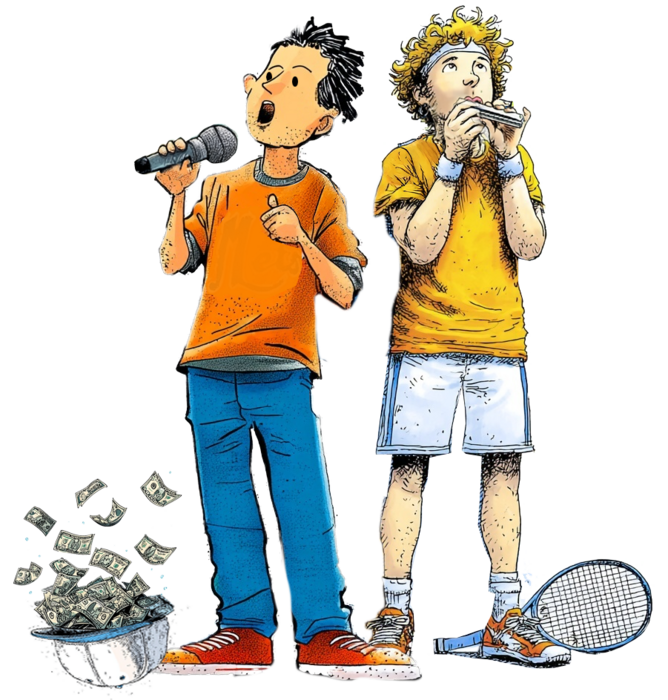
Amusement
Excerpt Setting: lSubway Platform between Shea Stadium and U.S. Open Tennis Complex (Queens, NY, 1990)
This excerpt was taken in the Fall of 1990 when I was routinely working in New York City monitoring clinical trials for our biopharma clients. I had the good fortune to time one of my trips to coincide with the U.S. Open, one of the top four Grand Slam tennis tournaments, competed at the enormous tennis complex at Flushing Meadows (Queens, NY). My brother, Rick accompanied me for the week as I would work during the day and then we would attend the tennis events in the evenings along with enjoying Manhattan’s museums, restaurants and other activities around town. On one particular evening, we were exiting the tennis and boarding the subway to take us back to town at the same switching station as where New York Mets baseball fans were also exiting their game following another dismal loss at Shea Stadium. When one of our friends started mocking their dour mood with his harmonica, for some inexplicable reason, I decided to chime in with a hearty rendition of Ernest Thayer’s famous poem, ‘Casey at the Bat’, while Rick passed the hat for donations. Certainly among my most AMUSING memories ever. Enjoy!
Sample #2
Ch 23 (A COOKIE for PUPPY GIRL) – There is No Joy in Mudville[1]
My work commitments continued to expand as each of my five active clients were asking for more and more of my time. I guess the good news for me, beyond the abundance of billable hours was that three of my clients had active sites in the New York City (NYC) area so I was routinely spending about one week per month handling the site monitoring duties at hospitals around town. Of course, the even better news was that I had always dreamed of attending one of the four major professional tennis tournaments, referred to as the Grand Slam, and I was able to schedule work in NYC during the second week of the U.S. Open. The event was held in Flushing Meadow, located in the borough of Queens and a short subway ride from midtown Manhattan where I routinely stayed during my work week. In fact, I had accumulated so many travel awards with the airlines, hotels and rental car agencies that I could usually upgrade to the fanciest hotels in town, which for this trip, I chose to stay at the elegant Plaza Hotel, just adjacent to the southern end of Central Park. In addition, my brother Rick was able to join me, staying for free by sharing my hotel room.
We flew to NYC on Labor Day (Monday), and proceeded to attend the evening session at the US Open on each of the following three days. It was great fun, especially for Rick, because I would get up and start work very early each day while he slept-in, enjoyed luxurious brunches, worked-out in Central Park and still had time to visit the art museums and other iconic landmarks nearby. Fortunately, I could return to the hotel with plenty of time for us to reach the tennis stadium by 6 pm, and often the highlighted matches would run well past midnight. Finally, on the third evening, we ran into Rick’s good friend, Bruce, who, if you recall was the one impersonating Mick Jaggar on Rick’s sailboat back in 1987 when he was lip-syncing ‘I Can’t Get No Satisfaction’ as we cruised by a Sausalito restaurant hosting U.S. Secretary of Defense, Caspar Weinberger. Apparently, Mick (as he was affectionately nicknamed) was also in town on business and had attended the day sessions at the tennis tournament. Rick and I had just finished watching Pete Sampras, an unknown Californian who won his quarter-final match, and not only went on to win the Men’s Open Singles Championship but also established himself as one of the greatest players ever.
That said, we all decided to leave the facility early and enjoy an evening in NYC together, and for those who know the subway layout in Queens, that particular station that we board to head back across the river to midtown is also the same platform that New York Mets fans access their home baseball field at Shea Stadium. As it turns out, their game was just ending as thousands of dejected Mets fans were grumbling over another unceremonious loss when Mick started playing his harmonica to capture the sullen mood. Surprisingly, even to me, I suddenly felt inspired to start reciting Ernest Thayer’s century old poem, ‘Casey at the Bat’ (Thayer, 1888) as Mick quickly blended his harmonica to my cadence:
The outlook wasn’t brilliant for the Mudville nine that day;
The score stood four to two with but one inning more to play.
An then when Coon died at first, and Barrows did the same,
A sickly silence fell upon the patrons of the game.
A straggling few got up to go in deep despair. The rest
Clung to that hope which springs eternal in the human breast;
They thought if only Casel could but get a whack at that–
We’d put up even money now with Casey at the bat.
But Flynn preceded Casey, as did also Jimmy Blake,
And the former was a lulu and the latter was a cake;
So, upon that stricken multitude grim melancholy sat,
For there seemed but little chance of Casey’s getting to the bat.
But Flynn let drive a single, to the wonderment of all,
And Blake, the much despised, tore the cover off the ball;
And when the dust had lifted, and men saw what had occurred,
There was Jimmy safe at second and Flynn a-hugging third.
Then from 5,000 throats and more there rose a lusty yell;
It rumbled through the valley, it rattled in the dell’
It knocked upon the mountain and recoiled upon the flat
For Casey, might Casey, was advancing to the bat.
There was ease in Casey’s manner as he stepped into his place;
There was pride in Casey’s bearing and a smile on Casey’s face.
And when, responding to the cheers, le lightly doffed his hat,
No stranger in the crowd could doubt ’twas Casey at the bat.
Ten thousand eyes were on him as he rubbed his hands with dirt;
Five thousand tongues applauded when he wiped them on his shirt.
Then while the writhing pitcheer ground the bal into his hip,
Defiance gleamed in Casey’s eye, a sneer curled Casey’s lip.
And now the leather-covered sphere came hurtling through the air,
And Casey stood a-watching it in haughty grandeur there.
Close by the sturdy batsman the ball unheeded sped–
“That ain’t my style,” said Casey. “Strike one,” the umpire said.
From the benches, black with people, there went up a muffled roar,
Like the beating of the storm-waves on a stern and distant shore.
“Kill him! Kill the umpire! shouted someone on the stand;
And it’s likely they’d have killed him had not Casey raised his hand.
With a smile of Christian charity great Casey’s visage shone;
He stilled the rising tumult; he bade the game go on;
He signaled to the pitcher, and once more the spheroid flew;
But Casey still ignored it, and the umpire said, “Strike two.”
“Fraud!” cried the maddened thousands, and echo answered fraud;
But one scornful look from Casey and the audience was awed.
They saw his face grow stern and cold, they saw his muscles strain,
And they knew that Casey wouldn’t let that ball go by again.
The sneer is gone from Casey’s lip, his teeth are clinched in hate;
He pounds with cruel violence his bat upon the plate.
And now the pitcher holds the ball, and now he lets it go,
And now the air is shattered by the force of Casey’s blow.
Oh, somewhere in this favored land the sun is shining bright;
The band is playing somewhere, and somewhere hearts are light,
And somewhere men are laughing, and somewhere chidren shout;
But there is no joy in Mudville–mighty Casey has struck out.
As it turns out, I only made it through a couple of verses before we were booed off of the platform, but not before my brother collected a couple of dollars in tips that were placed in his outreached hat as he mingled through the crowd. In reflection, there may not have been much joy in Mudville that night, but it remains one of my most AMUSING moments ever, and since it was the first time I was paid for my rousing recital, I now consider myself to be a professional street performer.
[1]Disclaimer: This excerpt and corresponding writing sample display some color but the actual book is in black and white.
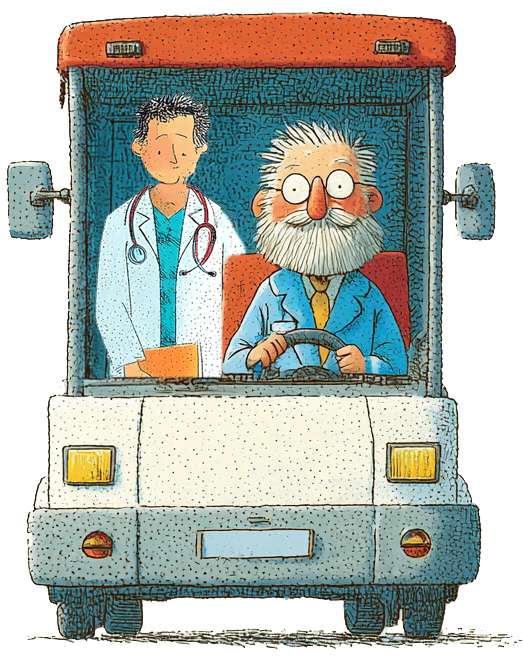
Amusement
Excerpt Setting: Chart House Restaurant (Portland, OR, 1985)
This excerpt was taken in the Spring of 1985 as I was just returning to Portland after spending the prior two years living at my parents’ home, working in the sawmill to pay off my student debt and tending to my grandmother’s estate following her passing. I was ready to start my career job search, post medical school, but in the meantime, I was hired on at a high-end, local restaurant with my roommates, Lane and George as well as others attending school at nearby OHSU. No one could have predicted the medical emergency we faced when an elderly gentleman, who lay dying on the floor of the restaurant from seizure-induced obstructed airways was rushed to us (outside in the parking lot) to save his life and the ironically humorous aftermath (AMUSEMENT) that resulted. Enjoy!
Sample #1
Ch 36 (A TURD in THE PICKLE JAR) – Bob the Bus Driver[1]
Yes, I was ready for the next chapter in my life, and it took about a second to discover that I had a job waiting for me back in Portland. Lane and George were finishing up their Senior year in medical school in a couple of short months and were interviewing at hospital programs around the country for their respective internships and residencies to follow. Meanwhile, an old roadside bar, ideally located on the side of the steep hill just below where OHSU was perched, had been under construction for the past year. It was originally called the Hill Villa and had been a favorite roadhouse (restaurant) since the 1920’s but, over time, it had become rundown and rumored to be home to ‘sketchy’ activities.
Many of us would follow the renovation progress routinely as it sat on Terwilliger Blvd, adjacent to one of the best running trails around until it was finally nearing completion, with a Grand Opening scheduled, as a part of a high-end chain of steak and seafood restaurants called the Chart House. Great success was anticipated as it had, and still has, the best view and sight lines of any restaurant in the Portland area, however, because of its location, there was very little room for parking. At this point of the story, allow me to introduce ‘Bob the Bus Driver’ as he was affectionately known to anyone who lived, worked or was in any way associated with OHSU and the adjoining hospital and medical facilities. Bob was an older gentleman who had been driving THE shuttle bus for decades, as he covered a several-mile loop all day long, faithfully delivering everyone to their destinations. Bob knew everyone by name and always had a kind word and a friendly smile, and was one of OHSU’s most precious treasures. This became more relevant to me because Bob accidentally overheard that a lawsuit was being filed by the inhabitants of the wealthy mansions adjacent to the Chart House. They were anticipating that the onslaught of restaurant goers would disrupt the serenity of their neighborhood at all hours of the day and night, while trying to find parking.
So, Bob came up with the brilliant idea to incorporate himself and offer valet services to the Chart House at a tremendously reduced cost, with the caveat that the restaurant’s managing company would cover the sizable insurance premiums for personal liability. In return, Bob would select and train all of the valets personally, and the only thing that the Chart House had to do was to hire the valets as employees at Oregon’s minimum wage of a whopping $3.10 per hour. Of course, Bob received a small fee for his efforts. The restaurant owner accepted his offer and Lane and George were two of his first hires. Bob didn’t stop there, as he used his extensive list of contacts among the medical, dental, nursing and graduate students attending OHSU, and selected about ten of us for hire. Yes, I did say ‘us’ as I had met Bob numerous times and he made an exception to hire me although I was a former student.
The restaurant’s Grand Opening had occurred a few days before I arrived in town, and within 48 hours of my arrival, I was gainfully employed. Interestingly, the lot would normally handle about thirty-five cars if the visitors were allowed to park their own car, but, with our plan of double and triple-parking system, we could squeeze about 120 cars into the lot. I admit that it was tight, and required constant vigilance of 5-6 of us, working in tandem, to continually move the cars so they would be ready for pick-up when called upon. In fact, after a six-hour shift, I probably covered at least ten miles, and the physical work-out was phenomenal. Each shift had a ‘key’ leader, such that any tips we might receive upon retrieving a car, would be handed off to the key, and at the end of the night he would calculate our individual shares based on the total hours we worked that day, because those who worked the at end of the night shift would otherwise receive a disproportionate share from those at the beginning. The tips would be sealed in an envelope and placed in our employee mailbox, and I was absolutely shocked when I picked up my first envelope the following day and there was well over $150 in cash. Recall that this was 1985, and I just earned $30/hour in tax-free income on top of my minimum wage. At that point, Bob called a group meeting and we all agreed to keep our ‘cash cow’ a secret because rumors were circulating in the restaurant that many of the employees were complaining that the headwaiters were making obscenely large tips but not sharing them with their support staff (e.g., bartenders, cocktail waitresses, cooks, food preparers, runners and dishwashers). To avoid being dragged into that mess and likely being asked to share our tips, we took a ‘vow of silence’.
Recall that I had bartended in college among fellow students and there was always camaraderie and mutual respect among us, however, at the Chart House, not so much. There was a pecking order based on the perceived status of the position held, with the headwaiters at the very top, and as you might guess, the parking lot valets at the very bottom. Of course, there were several attractive female workers inside, and in a slow moment, we might try to flirt, but most of them would have none of that, after all, we were lowly, ‘parking-lot Valets’. For example, extra food was often shared with the employees after they finished their shift, and it was common that the bartender might pour an ‘on-the-house’ beer or glass of wine when they ‘clocked out’, but never for us, ever. It wasn’t important enough to be of concern because we continued to average about $150 per night over the remainder of the year.
That all changed one Sunday afternoon in June, when a section of the restaurant had been cordoned off for a private, 80th birthday celebration among a group of about fitty people. As a result, the remainder of the bar and restaurant was extra busy to accommodate all of the other patrons when suddenly, the older, ‘birthday gentleman’ had a seizure and fell face forward into the table. We were outside in the parking lot, near the front door when we heard someone scream, “Call 911”. Within seconds, the head manager and assistant manager ran upstairs from their office, picked up the gentleman, still in his chair and ran him outside and sat him down next to us. Luckily, both Lane and George were working that day, so Lane laid him on his side and supported his head while George took a spoon and cleared his tongue which he had swallowed and now blocking his airway. The seizure subsided and the gentleman, after gasping for air, sat up in a bit of shock and thanked us for our quick action. When the paramedics arrived in their ambulance from nearby OHSU about five-minutes later, they were at first confused, but once it was explained that these were trained doctors, and they had likely saved this guy’s life, the secret was out.
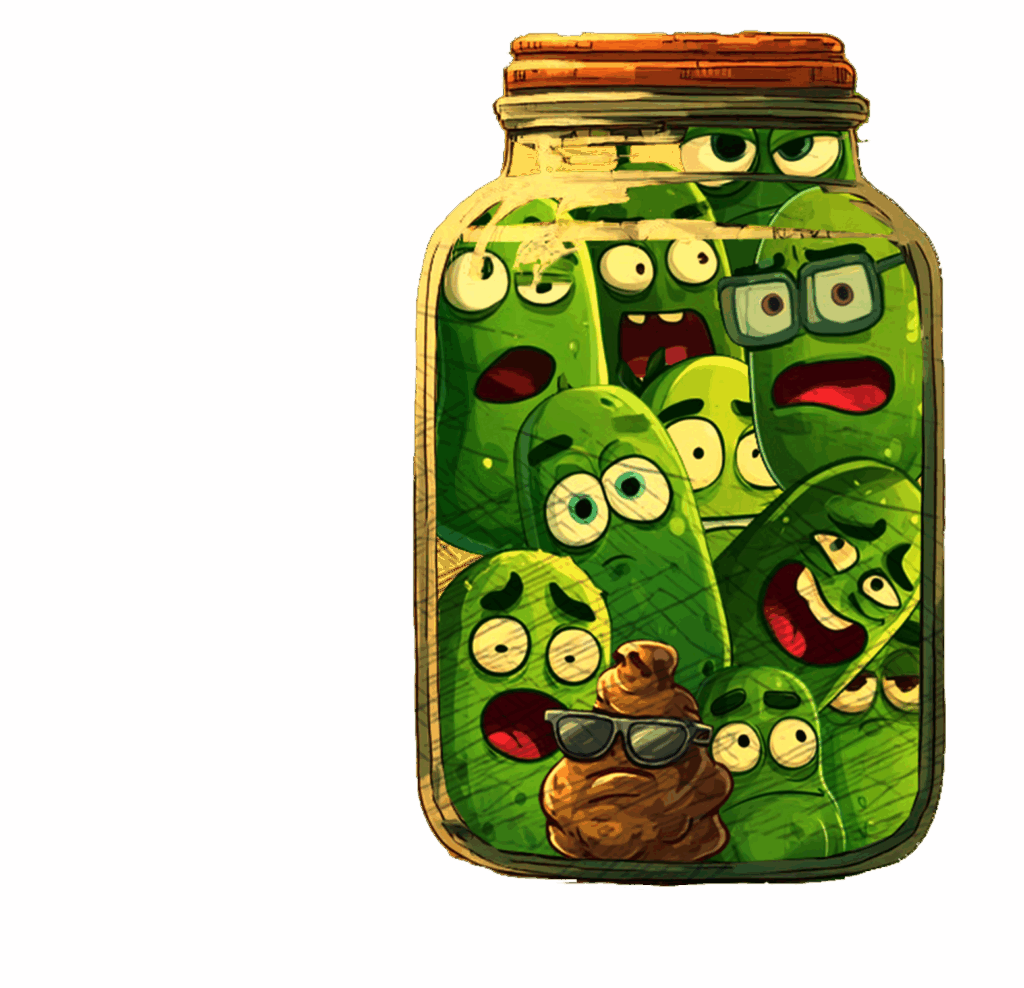
In reflection, this is still one of my favorite stories (AMUSEMENT) of all time to share. Needless to say, our status among our peers immediately improved, but it was humorous as those who had been so rude to us or just plain ignored us, were now our new, best friends. If a Filet Mignon or lobster had been sent back to the kitchen by a patron because it wasn’t prepared properly, we might actually be offered a piece, and the bartenders were all too eager to offer up a beer after a long evening in the rain. In fact, it is only appropriate that I offer up a Turd in the Pickle Jar Award[2]collectively to many of our fellow workers. For what it is worth, relations did improve and no one learned about our lucrative tips, at least during the year I worked at the Chart House.
[1]Disclaimer: This excerpt and corresponding writing sample display some color but the actual book is in black and white.
[2] Inspired by and awarded to those toxic individuals who seem to disrupt the vibe for everyone else at a gathering, after all, it only takes one to ruin it for all! Note that this image uses color whereas the actual memoir is in black and white.
Define Amusement
A positive emotional state linked to experiences perceived as humorous or entertaining. This state is associated with:
- Pleasure and Happiness: Amusement brings about feelings of delight and enjoyment;
- Laughter and Smiles: These are common expressions of amusement, especially as the intensity of the emotion increases;
- High Physiological Arousal: Amusement is linked to increased physiological activation;
- Cognitive Shift: Humor often involves a sudden understanding or change in perspective, leading to the experience of amusement (Google, 2025);
Google (2025). AI Overviews [Generative AI Feature]. Definition of amusement. Retrieved from Definition of Amusement.
Note that this [URL] link is for a Google AI Overview so the actual content provided on line may differ slightly from the description that is printed above.
Manage Amusement
Managing amusement emotions, like any other strong feeling, involves recognizing the emotion, accepting it and then employing techniques to regulate it. Realize that amusement is generally considered a positive emotion but, in some cases, it can be overwhelming due to sensory overload (e.g., amusement parks), anxiety or phobias.
Recognize and Accept:
- Acknowledge that you are experiencing amusement, and understand the physical and mental sensations associated with it;
- Don’t try to suppress or deny the emotion. Allow yourself to feel amusement without judgment;
Regulate the Intensity:
- Mindfulness: Practice mindfulness techniques like meditation to increase awareness of your emotions and develop the ability to observe them without judgment;
- Deep breathing: When feeling overwhelmed by amusement, deep, slow breaths can help regulate your nervous system and promote a sense of calm;
- Grounding techniques: Engage your senses to connect with the present moment. This could involve noticing five things you can see, four things you can touch, three things you can hear, two things you can smell and one thing you can taste;
- Physical activity: Exercise can be a healthy way to release energy and emotions;
- Creative Expression: Journaling, drawing or engaging in other creative activities can help process and express emotions;
- Social support: Talk to a trusted friend, family member or therapist about your experience;
- Self-compassion: Treat yourself with kindness and understanding, especially when dealing with strong emotions;
Seek Professional Help:
- If you struggle to manage your emotions or experience them intensely and frequently, consider seeking professional support from a therapist or counselor (Google, 2025);
Google (2025). AI Overviews [Generative AI Feature]. Managing Amusement. Retrieved from Managing Amusement.
Note that this [URL] link is for a Google AI Overview so the actual content provided on line may differ slightly from the description that is printed above.